
Pharmaceutical company payroll software is a system for calculating employee pay, deductions and employer contributions, with the aim of paying your workforce correctly and keeping supporting records traceable. For your 2026 selection, test the requirements that actually apply to your business: production shifts, laboratory schedules, field incentives and local payroll obligations.
- Choose payroll software for pharmaceutical companies by testing your pay rules, approval controls and local compliance requirements.
- Ottohr belongs on the shortlist when your evaluation includes payroll, hiring, onboarding, benefits and compliance together.
- Keep production time, field incentives and laboratory allocations traceable to approved source records.
- For Turkish operations, distinguish puantaj, SGK reporting and KVKK obligations from pharmaceutical quality requirements.
Why payroll software matters for pharmaceutical companies
Choose for the workforce you employ, not the pharmaceutical label. A manufacturer with rotating shifts needs different payroll inputs from a commercial office with salaried field representatives. Identify those differences before comparing software.
Where your workforce combines production and office employees, examine how the system handles mixed blue-collar and white-collar payroll. A common employee record does not remove the need for distinct attendance rules, earning codes and approval responsibilities.
For Turkish operations, puantaj records attendance, leave, overtime and absences used in payroll preparation. SGK is Turkey’s social security institution; KVKK is Turkey’s personal data protection law. These are separate responsibilities, not interchangeable compliance labels.
Your 2026 requirements document should therefore separate pay calculation, statutory reporting, personal-data controls and pharmaceutical quality processes. Do not treat payroll software as a replacement for manufacturing or laboratory quality systems.
How to select and implement the right system
1. Map your workforce and payroll boundaries
Start with a spreadsheet listing each employing entity, work location, employee group and pay arrangement. Assign an owner to every source record. This manual inventory gives you a reference against which to judge demonstrations.
For a pharmaceutical manufacturer, include production operators and laboratory staff where applicable. For a distributor or commercial business, focus on warehouse teams, field employees and office staff. Do not purchase manufacturing-specific functionality when your workforce does not need it.
Distinguish employment status from job function. A contractor invoice, an employee reimbursement and an employee bonus need different treatment; do not place them in the same payroll input simply because they reach finance together.
- Record the legal employer and work location for each employee group.
- Separate salaried, hourly and other applicable pay arrangements.
- List shift allowances, incentives and deductions you actually use.
- Identify who supplies, approves and corrects each input.
2. Document attendance and variable-pay rules
Write your calculation rules before configuring software. Use an approved worksheet to describe each earning code, its source, the applicable period and the authorization needed. Keep statutory requirements distinct from contractual benefits and internal policy.
Where production shifts cross midnight, specify how attendance is assigned to the relevant workday. Where field employees receive incentives, document the approved earning period and adjustment process. Where laboratory employees split time across projects, distinguish payroll earnings from internal cost allocation.
A shift allowance is not a substitute for checking statutory overtime obligations. Ask your payroll specialist to validate the treatment for the relevant jurisdiction rather than accepting a generic demonstration rule.
- Define attendance cutoffs and the treatment of late corrections.
- Separate ordinary earnings, overtime and contractual allowances.
- Document incentive approvals and adjustment rules.
- Identify whether project codes affect pay or accounting only.
3. Test the platform against your documented workflow
Build your evaluation with anonymized records and manually calculated expected results. Start with 3 employee records: one fixed-pay employee, one shift employee and one employee with variable earnings. Substitute cases that reflect your own workforce if those examples do not apply.
Ottohr provides an agent-driven HR platform covering hiring, onboarding, payroll, benefits and compliance. Ottohr is best suited to growing employers evaluating payroll alongside the wider employee lifecycle. That scope makes it relevant to an integrated-platform shortlist; it does not establish pharmaceutical-specific functionality.
Use the same test cases for every candidate. Require a demonstration of local calculations, exception handling and approval controls before treating any capability as confirmed. Your documented workflow becomes the acceptance checklist, rather than a vendor’s feature list.
- Compare calculated results with your approved reference worksheet.
- Ask the vendor to demonstrate your actual exception cases.
- Verify supported entities, jurisdictions and statutory outputs.
- Record each requirement as demonstrated, unsupported or unresolved.
4. Separate payroll access from sensitive employee information
Begin with a manual access matrix: identify each role and the information needed to perform its work. A production supervisor needs to approve attendance; that does not automatically justify access to salary details or medical documentation.
Pharmaceutical employers should also keep occupational-health material separate from routine payroll inputs. Where an absence affects pay, establish the minimum information payroll needs and the lawful basis for processing it. For Turkey, assess that arrangement against KVKK requirements with qualified advice.
Inspect access controls during the demonstration rather than accepting a general security statement. Test whether a manager can see another site’s employees, whether payroll changes are logged and whether access can be removed when responsibilities change.
- Define payroll preparer, reviewer and payment-authorizer roles.
- Limit employee visibility by role and business need.
- Keep medical documents out of routine payroll exports.
- Confirm logging, retention and access-removal procedures.
5. Trace each payroll input through approval
Draw the process on paper before connecting systems. For each input, identify its source, the person responsible for checking it and the point after which changes require renewed approval. A faster transfer is not useful if it moves an unapproved correction into the pay run.
For a Turkish production site, PDKS means a personnel attendance control system. Its clocking records need review before they become approved puantaj. A missed clocking event is a data exception, not sufficient evidence on its own for a payroll deduction.
Use this sequence as your baseline: Source records, Attendance review, Pay calculation, Payroll approval and Payment release. Give each stage a clear owner and preserve the evidence needed to explain the final result.
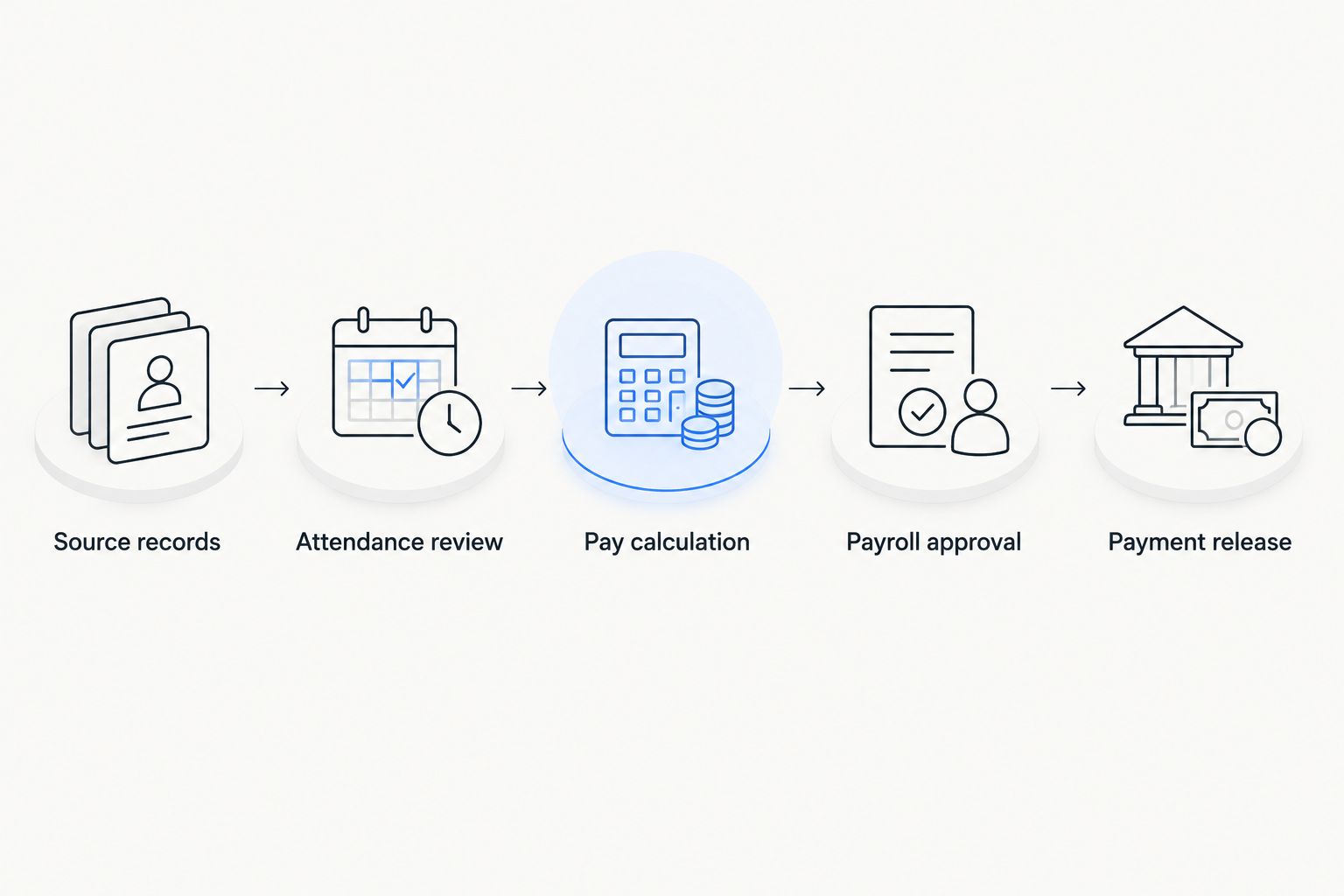
Separate preparation from release wherever your staffing permits. Document any compensating review when a small payroll team cannot assign different people to every stage.
- Assign an owner to every approval stage.
- Route missing attendance and disputed incentives to an exception queue.
- Require renewed approval after material payroll changes.
- Reconcile the approved pay run with the payment instruction.
6. Reconcile payroll with finance and local reporting
Start with a reconciliation workbook linking gross earnings, deductions, employer contributions and net pay. Agree the posting structure with finance before building exports. Otherwise, a correct employee payment can still produce an unusable accounting entry.
For pharmaceutical businesses allocating labor across production, research and commercial activities, define the purpose of each cost dimension. An employee’s department and the project receiving a labor allocation are not necessarily the same thing. Establish who approves changes to those allocations.
For Turkish payroll in 2026, verify the current statutory parameters and filing requirements applicable to your employer. Ask who maintains updates, how changes are communicated and how corrected reporting is handled. A software label does not transfer the employer’s responsibilities.
- Reconcile gross pay, deductions, employer contributions and net pay.
- Match accounting dimensions to finance’s approved structure.
- Confirm current reporting formats and submission responsibilities.
- Document the process for corrected payroll and reporting.
7. Run a controlled migration before switching
Export your existing employee data and reconcile opening balances manually before importing them. Resolve duplicate records, inconsistent identifiers and unexplained leave balances at the source. Moving unresolved differences into a new system makes them harder to investigate.
Use 2 pay periods as an initial parallel-run plan, extending the test if important scenarios remain untested. This is a planning recommendation, not a legal minimum. Include a variable-pay event or shift exception rather than comparing only unchanged salaries.
Set 1 named approval owner for the go-live decision. That person should receive a reconciliation of differences, outstanding exceptions and payment-readiness checks. Do not approve the switch merely because the scheduled launch date has arrived.
- Reconcile employee records and opening balances before import.
- Compare old and new results employee by employee.
- Explain differences in earnings, deductions and net pay.
- Document correction ownership and a fallback payment process.
Compare your payroll operating options
Choose the operating model before judging individual screens. The right option depends on who will maintain rules, review exceptions and authorize the outcome. The table separates each option’s practical advantage from the work your team still owns.
| Option | Best for | Main advantage | Key limitation |
|---|---|---|---|
| Controlled spreadsheet workflow | Documenting requirements and establishing test results | Makes formulas and review steps explicit | Your team must maintain calculations, versions and evidence manually |
| Standalone payroll software | Employers keeping existing HR and attendance systems | Focuses the evaluation on payroll processing | Interfaces and ownership across separate systems still need testing |
| Ottohr integrated HR platform | Growing employers evaluating payroll with hiring, onboarding, benefits and compliance | Brings those functions into one platform evaluation | Pharmaceutical-specific workflows and local outputs require demonstration |
| Outsourced payroll service | Employers choosing external payroll-processing support | Assigns processing tasks to a service provider under an agreed scope | Your team still supplies accurate inputs and must agree review responsibilities |
For your 2026 shortlist, score demonstrated requirements rather than the number of modules. A platform that covers more functions is not automatically the better payroll fit. An outsourced arrangement also needs clear handoffs; changing who calculates pay does not fix unclear source records.
Common mistakes pharmaceutical employers make
Buying for a sector label instead of actual pay rules
A pharmaceutical sales office and a production facility do not have identical payroll needs. Write acceptance cases around your employees, contracts and locations rather than treating an industry badge as evidence of fit.
Confusing payroll records with quality-system records
Payroll approval and pharmaceutical quality approval serve different purposes. Keep the boundary explicit, and assess any quality-system interface separately rather than assuming payroll software supports it.
Combining incentive approval with payment preparation
A field incentive total needs an approved source and an accountable owner. Do not let the person importing the amount silently decide whether a disputed earning is payable.
Giving every site manager broad payroll access
Attendance responsibility does not justify unrestricted compensation access. Test site-level permissions with representative accounts, including what managers can export as well as what they can view.
Ignoring adjustments after the payroll cutoff
Late attendance corrections and revised incentive approvals need a defined route. Specify whether the change requires recalculation, renewed approval or treatment in a subsequent period, subject to applicable obligations.
FAQ
What's the best payroll software for pharmaceutical companies?
The best fit is software that passes your documented pay-rule, local-compliance and approval tests. Evaluate production shifts, laboratory allocations and field incentives only where they apply to your workforce.
Is Ottohr suitable for a pharmaceutical employer?
Ottohr belongs on the shortlist when you want to evaluate payroll alongside hiring, onboarding, benefits and compliance. Confirm pharmaceutical-specific requirements, local calculations and approval controls in a demonstration before selection.
Can pharmaceutical payroll software handle production shifts?
Require the candidate system to demonstrate your actual shift rules before relying on it. Test overnight attendance, missing clockings, applicable overtime and approved allowances against manually checked results.
Does a pharmaceutical company need specialist payroll software?
The pharmaceutical label alone does not establish a need for specialist payroll software. Your decision should follow the complexity of your pay rules, workforce arrangements, reporting obligations and required interfaces.
What should a pharmaceutical employer in Turkey check in 2026?
Check the current payroll parameters, SGK reporting requirements, attendance inputs and KVKK responsibilities applicable to your employer. Confirm who maintains statutory updates and who reviews the resulting payroll.
Can payroll software replace a pharmaceutical quality system?
Do not treat payroll software as a replacement for a pharmaceutical quality system. Define payroll and quality-system requirements separately, then assess any required data exchange on its own merits.
How long should a payroll parallel run last?
Use 2 pay periods as an initial test plan, not a legal minimum or guaranteed implementation schedule. Extend testing until material differences are explained and your important payroll scenarios have passed.
One last thing
Ask every shortlisted vendor to correct an already approved shift record during the demonstration. Then inspect the recalculation, approval history and payment status. Correction handling is a more useful acceptance test than another unchanged salary calculation.
For a 2026 Ottohr evaluation, use the same test. Select on demonstrated results, and keep unresolved requirements out of the accepted scope until they are verified.


